Monday, 23 September 2013

GIVERS OR GRABBERS


Our developmental journey includes the task of sharing. The purpose and direction of this lesson is the ability to functionally live in community with others - where giving and taking is a necessary social consideration.

Definitions:

Givers: those who realize that happiness comes through serving others; they do not only give money and gifts but time, energy and attention.

Grabbers: those whose life is dedicated to grasping. They search for something for nothing. They are self-absorbed and constantly talk of money, of themselves and are looking to gain advantage at every turn.

What makes one person a Taker while others give readily?

Psychologically it all boils down to how we interpret the ‘psychological strokes’ we receive for giving, are they positive or negative, conditional or unconditional ?

Definition of a Psychological Stroke: Strokes are the recognition, attention or responsiveness that one person gives another. Strokes can be positive (nicknamed "warm fuzzies") or negative ("cold pricklies").   www.crossroads.sandler.com


There are also conditional and unconditional strokes:

A Conditional Stroke: is received for something you did. (Doing)

An Unconditional Stroke: is received for something you are. (Being)

As we know children model the adults around them; therefore giving and receiving becomes an important opportunity for teaching. If we have not been nurtured with unconditional positive regard, we may seek our ‘warm fuzzies’ more from what we do than who we are.  If we are lacking in positive unconditional strokes, our only access to positive regard will be positive conditional strokes.  We will ‘do’ rather than ‘be’. 

This gives rise to those who posture as Givers when in fact they are Grabbers.

When individuals posture as Givers, sometimes it takes a pretty good “detector” to tell the difference, but the telltale sign is always in the subtle emptiness of their relationship abilities. Grabbers give with wrong motive, the ultimate goal being for some kind of return. In giving, the reward may be to foster a certain image, or an overall feeling of indebtedness in you. This is a sad fact.
Mark Goulston: Psychology Today

Another sad psychological adage is that Grabbers often insist on seeing themselves as Givers and they will be the first to tell you so.  “In my thirty years of practice, I'd say this has been true about 80% of the time.”- Bill McDonald (McDonald & Kimball PLC)

Next we get the ‘Over-giver’; when the hunger for love has been betrayed, their Self is broken and poisoned and they give out of fear and anxiety in order to be found acceptable.

In recognising ourselves in any of these scenarios, we can turn the tables on this weakness:


A.   The Grabbers must stop and begin to realise their abuse of others. Only then can they begin the deeper work on self; growing toward becoming a ‘healthy Giver’.

B.   Over-givers must begin work deeply on self to become come healthy balanced Givers. 


How do we recognise a ‘true Giver’?   
Overwhelming willingness to give of their time, energy and attention.  

And while we are on the subject; be a Psychological Stroke Counter – make it a goal to increase the number of ‘warm fuzzies’ that you give to those around you.


Tuesday, 17 September 2013

DISAPPOINTMENT - UNMET EXPECTATIONS


“Ultimately the whole and the broken live side by side in us all.”
– E Frankel

Weiner et al (1979) found that disappointment is one of the most frequently experienced emotions.

Rabbi Harold Kushner asks, “How do people cope with the realisation that the important dimensions of their lives will not turn out as they hoped they would?” We all experience disappointment. 

Disappointment is defined as an experience of sadness involving unfulfilled hopes or expectations. Disappointment forces you to admit that you did not get what you hoped for and it is actually easier for you to protest with anger than it is to encounter your sadness around the course of events. Disappointment is the acceptance of reality.

There is foremost a disappointment in ourselves that drops our spirit into the lowest of lows, creating obstacles that we must overcome within ourselves as we are held back and kept from reaching our goals. Our bodies react with a chemical response that leads to melancholy, inertia and a feeling of hopelessness.

Every disappointment, every rejection, every dream that doesn’t come true leaves a wound on a person’s soul. - Kushner

What are some of the causes of our disappointment? 

·       Perfectionism: a perfectionist lives in a fantasy world; we have to be real regarding our expectations.

·       Overconfidence: people who embrace uncertainty are the ones who manage to face problems. Uncertainty is acceptable.

·       Setting unrealistic goals: be realistic, start with an accessible goal and build from there.

·       False ideas about rejection or failure: failure is only feedback telling you that you should change your way, be more flexible or try harder. Do not fear failure.

Disappointment is merely an unmet expectation, it’s only when you imbue it with negative meanings that it becomes painful - Goulston. 

It is how we respond to disappointment that is crucial. Do we respond with bitterness, envy and self-doubt or with wisdom and resilience? 

Overcoming Life’s disappointments:

1.    Revise expectations; “kyk weer” as we say in Afrikaans, take a second look at your expectations, were they unrealistic?

2.    Increase your resilience to disappointment; do not allow it to lead you to pessimistic thoughts. 

3.    Use humour to reframe the disappointment.  A new study finds that positive reframing i.e. looking at a circumstance in a different light and perhaps laughing about setbacks is an effective way to feel satisfied at the end of the day. Yet we acknowledge that not everything can be seen through a humorous lens.


“If we will be quiet and ready, we shall find compensation in every disappointment” – Henry David Thoreau.  
I believe there are always ‘treasures in the darkness’, we just have to search or look back in order to acknowledge lessons learnt. We also have to acknowledge that if life did not challenge us, we would not know how strong we are.

A most invaluable lesson we can all learn is that life is about facing our past with gratitude and our future with confidence. Even as we carry with us the memories of dreams that never came true; there are always more attainable dreams awaiting us.

“ The worth of a person’s soul is not measured by his/her bank account or the volume of the applause a person evokes but by one’s humanity, by one’s compassion, even by the courage to keep on dreaming amid the broken pieces of our earlier dreams.  True success consists not in becoming the person you dreamed of being when you were young, but in becoming the person you were meant to be, the person you are capable of being when you are at your best." - Kushner


Keep on dreaming.


 Resources
  • The cognition–emotion process in achievement-related contexts. Weiner, Bernard; Russell, Dan; Lerman, David Journal of Personality and Social Psychology, Vol 37(7), Jul 1979, 1211-1220. doi: 10.1037/0022-3514.37.7.1211
  • Dr. Mark Goulston, Psychology Today.
  • Harold. S Kushner, Overcoming Life’s disappointments, 2007

Tuesday, 10 September 2013

DRAMATIC AND ERRATIC Part 1

- TOOLS OF THE TRADE

'Dramatic-Erratic' people live amongst us; we all know someone who fits the profile. What tools do they use? Let’s take a look so that we are equipped for our journey with them.

TOOL 1


Lack of Empathy

In 2008 Barack Obama received a letter from an 8 year old girl on the importance of recycling and banning wars; he thanked her and offered some advice of his own in reply: “If you don’t already know what it means, I want you to look up the word ‘empathy’ in the dictionary. I believe we don’t have enough empathy in our world today, and it is up to your generation to change that.” 

The word “empathy”—a rendering of the German Einfühlung, “feeling into”—is only a century old, but people have been interested for a long time in the moral implications of feeling our way into the lives of others. Albert Adler states that empathy is seeing with the eyes of another, listening with the ears of another, and feeling with the heart of another.

If we begin with the acknowledgement that a person reveals who they are through their personality; this is directly related to a person's perception of reality and how they fit into it. We can follow a person's basest insights acknowledging them to be their personal values, which are the foundation of their behaviour and thinking.

A person's core coping skills is related to how they cope with Honesty, Justice and Empathy.(Anthony)

The ‘dramatic-erratic’ among us lack empathy. They simply do not care about thoughts and feelings that conflict with their own. We, therefore, cannot expect them to listen, validate, understand, or support us. Their behaviour feels more like a game of tug of war.

TOOL 2
Lying
Pathological lying refers to the ‘dramatic-erratic’ who lie constantly to get their way and do so with little concern, regard or respect for the feelings and rights of others. Pathological liars are often goal-oriented as long as they get their own way. They present as manipulative, cunning and egotistical.

A pathological liar might exhibit the following behaviours:

  • Lie to control and get their own way
  • Change stories often
  • Exaggerate, lying about almost everything, but tell the truth about major things
  • Not value truth
  • Live in their own reality most of the time
  • Behave defensively when questioned or challenged
  • Lie to gain sympathy
  • Don’t admit they lie
  • Contradict what they say because they don’t remember their lies

The ‘dramatic-erratic’ lie to manipulate and exploit, they lie to others and themselves because they do not understand the truth.

TOOL 3
Manipulation/Exploitation

Clay Watkins states that secrecy is what gives manipulators their power. When we recognize and label how someone is manipulating us, we empower ourselves. We strip the manipulator of his or her power over us. 


We can counter with our very own Power Tools:

1.    JADE - Don’t Justify, Argue, Defend & Explain. We must stop circular conversations (Arguments which go on almost endlessly, repeating the same patterns with no resolution).

2.    The 50% Rule - The 50% Rule says that we are responsible for 50% of the things that happen in any relationship. Be aware of your responses. Speak the truth in love.

3.    Rescuer Syndrome - Be aware of Rescuer Syndrome. Don’t assume that your strength, skill and knowledge are adequate to compensate for another’s poor or bad behaviour.
outofthefog.net/


May our relationships flourish as we continue to instil clear boundaries so that we can live life abundantly!


Wednesday, 4 September 2013

RANDOM OR PREDICTABLE?


In ancient history, the concepts of chance and randomness were intertwined with that of fate. Many ancient peoples threw dice to determine fate, and this later evolved into games of chance.
Most ancient cultures used various methods of divination to attempt to circumvent randomness and fate.

Randomness or predictability?
Martin Luther believed that absolute free will and unbounded randomness are extremely limited to the point that behaviours may even be ordered and not random. This is a point emphasized by the field of behavioural psychology. Give a behaviourist random subjects and they determine to condition them to behave in certain patterns.

 "Give me a dozen healthy infants, well-formed, and my own specified world to bring them up in and I'll guarantee to take any one at random and train him to become any type of specialist I might select - doctor, lawyer, artist, merchant-chief and, yes, even beggar-man and thief, regardless of his talents, penchants, tendencies, abilities, vocations, and race of his ancestors."
--John Watson, 1930

 What about pre determination or free will?

C. S. Lewis, a 20th-century Christian philosopher, discussed free will at length. On the matter of human will, Lewis wrote: "God willed the free will of men (and angels) in spite of His knowledge that it could lead in some cases to sin and to suffering: i.e.He thought freedom worth creating even at that price."

Thoughts of randomness raise themselves in times of crisis, suddenly we are faced with the ‘Why’ question? There seems to be “No sense”.... we know that we believe in an orderliness to life; nature reflects it and scientists observe and count on it every day...yet loss makes the universe a cold unfriendly place. Thoughts run through our minds which in the end is often illogical and outside of our control – an “accident”. An act of free will. Randomness.

Jerry Sittzer author of “A grace disguised” talks of The Terror of Randomness: that shocking moment when life as we know it changes forever.

Affliction is anonymous; it deprives its victims of their personality and makes them into things. It is indifferent; and it is the coldness of this indifference – a metallic coldness – that freezes all those it touches right to the depths of their souls. They will never find warmth again.  They will never believe anymore that they are anyone (Simon Weil).  

For those who have experienced this; suffering may be at its fiercest when it seems random...Wrong place at the Wrong time.

Sittzer states that loss may appear to be random but that does not mean it is. It may fit into a scheme that moves beyond even what our imaginations dare not think.

I believe that the ‘road along a belief in randomness’ finally ends in bitterness. It is better to give up our pursuit for control and live in hope. We love again and live again; we hope again. Deep understanding of our own pain makes it possible for us to translate our weakness into strength and to offer our own experiences as a basis of healing to those who are now suffering.

This is a redemptive cycle we can all play a part in; when we have journeyed through struggles and thoughts of randomness to a place of acceptance, our experience is not for us alone but for those who follow after.

To keep a lamp burning, we have to keep putting oil in it – Mother Theresa.


You can also be that oil in another’s lamp! 


Wednesday, 28 August 2013

REGENERATION

 
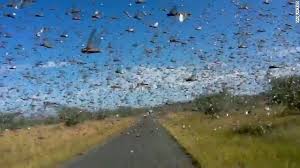
Locusts started invading Madagascar in November 2011. Due to political unrest no solution could be reached internationally to their cries for aid.  In February 2013, Cyclone Haruna struck,  creating optimal conditions for locust breeding.
 
By late March 2013, approximately 50% of the country was infested by swarms of locusts, with each swarm consisting of more than one billion insects. The authorities changed the situation to plague status. According to one eyewitness, “You don't see anything except locusts. You turn around, there are locusts everywhere" – Wikipedia

"The UN estimates that about two-thirds of the island country will be affected by the locust plague by September 2013 if no action is taken."- BBC. There are talks of famine as the swarms decimate the rice yield.

Eating locusts: the crunchy, kosher snack taking Israel by swarm - Hebblethwaite


In Israel, locust swarms are periodic and although you cannot eat yourself out of a plague, locusts are kosher and are eaten as a delicacy. For the uninitiated, they are served crunchy - an effect that is best achieved as follows:

Drop them into a boiling broth, clean them off, and roll in a mixture of flour, coriander seeds, garlic and chilli powder. Then deep-fry them.

Pan-frying is another good option, and they are "crunchy, tasty and sweet” mixed with caramel and sprinkled into meringue.

Locusts are high in protein, and also zinc and iron - minerals which many people around the world are lacking - and they emit very little in the way of greenhouse gases.

Locusts are a valuable source of income for women in Niger, who get up early to collect them from the millet fields, and then sell them at the market. They make more money from the locusts on the millet than the millet itself.

Arnold van Huis, Professor of Tropical Entomology at Wageningen University in the Netherlands is one of the world's leading advocates for eating insects.

Could it be that what has become a Crisis situation in Madagascar may, with education, have a silver lining? Could the scourge of famine actually have been provision?

LOCUST SWARM AS A REFLECTION OF A PERSONAL LIFE CRISIS

I believe there are lessons within these news articles for all of us: 

1.     “You don't see anything except locusts. You turn around, there are locusts everywhere" – Our own trauma can blind us to all else.  Initially, this is perfectly normal; there seems no escape, no solution!

2.    “2/3 of the country will be infected if no action is taken” – Our crisis may become progressive, overwhelming us. We need help from outside of ourselves, we cannot find solutions to every crisis alone.

3.    Talks of famine – Negative thinking blocks our minds, negative talk  demotivates us. We may become fearful and even experience a sense of hopelessnessv.

4.    Locusts are high in protein, and also zinc and iron; Locusts are a valuable source of income for women in Niger - There are so often solutions found in the wisdom of counsel, direction and in the provision of God. God can turn our mourning into dancing. 
 
5. Locusts turn out to be provision and a means of delicious food! - Trials can definitely turn into blessings with the right ingredients!

Could it be that in the midst of our “swarm”or even our "plague",  there are treasures to be found?  The very “locust” which causes such destruction, such havoc; could it also be the means to our salvation?


Could this be?

A place where growth occurs

A place for creativity

 A place where values are explored


Something to think about...


Friday, 23 August 2013

THE SOUND OF SILENCE


A tree falls in the forest and no one is around to hear it….does it make a sound?

The definition of sound is "something that you hear." No one's there to hear the tree fall…is there sound? 

I realised in reading this that it is an astonishing picture of periods in my life when I feel alone. Have you ever felt like “no one has heard the tree fall” in your life, no one really acknowledges your crisis or loss: you feel so alone in an experience that it is as if no one noticed…there was no sound, no one sees your pain? 

We need someone to acknowledge our pain, to be there for us so that we can share and find meaning in our experience.

We need others. We need fellowship i.e. “the condition of sharing similar interests, ideals, or experiences, as by reason of profession, religion, or nationality or the companionship of individuals in a congenial atmosphere and on equal terms”.


Loneliness has negative connotations in our society and manifests in a sense of isolation. 
We feel that there is a void but at the same time must acknowledge that it is possible to be with the wrong people and still feel lonely—perhaps the most bitter form of loneliness.

Solitude on the other hand, is something you choose. Solitude restores body and mind where as loneliness seems to deplete them.

Paul Tillich believes that loneliness expresses the pain of being alone and solitude expresses the glory of being alone. 
Subsequently, we begin to realise that there is more here than mere words; our minds need to engage with this in order to make sense of “being alone”.

It would seem that there is a journey, a path and a wilderness to walk through and the challenge of this journey is in finding our way from a place of loneliness, this wilderness to a place of solitude.

Henri Nouwen states in his Pathways to Life and the Spirit that a waiting person is someone who is present to the moment, believing that this moment is ‘the’ moment. He leads us to believe that living in the present is the means of navigating this pathway we seek. Enjoying each moment for what it holds.


Isolation is aloneness that feels forced upon you, like a punishment. 
Solitude is aloneness you choose and embrace (Jeanne Marie Laskas).  
I believe great things can come out of solitude; out of going to a place where all is quiet except the beating of your own heart. You have to search out that place of being…being comfortable, being by yourself in order to truly open yourself up to what you want most.

“The pain in loneliness comes from all that surrounds it, not the act itself. And when you spend enough quality time alone, you realize that it is indeed nothing to fear. You realize that you, by yourself, are happy and are confirmed in life and worth by everything around you. And though it will not take the edge off of the painful moments that lead to us being alone, it is worth reminding ourselves that just because we’re eating alone at a restaurant doesn’t mean we aren’t in wonderful company!” 
– C Fagan, Paris


In the waiting embark on this journey out of loneliness, ask the question; can we separate our being ‘alone’ from being ‘lonely’? Can we find comfort in being alone?

I have walked this road on many an occasion and am entirely a better person for it. 


Sunday, 18 August 2013

METAMORPH


A Caterpillar becomes A Beautiful Butterfly

Our striving for joy, contentment and happiness can in reality seem like a fuzzy dream. 
A caterpillar crawling along a leaf one day, looked up and saw a beautiful butterfly passing overhead and wondered: 'I would love to be like her; is it possible, could this happen to me someday?'

Now in adulting we know that the cost is high and the means complex for the caterpillar’s dream to become a reality. The transformation from caterpillar to chrysalis to butterfly is a perfect metaphor for what we may experience in life. 

An interesting fact to begin: In ancient Greece the word for soul or psyche was often described as a butterfly.

And so…Once upon a time……

A man found a cocoon of a butterfly. One day a small opening appeared, he sat and watched the butterfly for several hours as it struggled to force its body through that little hole.

And then …..it seemed to stop making any progress. It appeared as if it had gotten as far as it could and it could go no farther. 

O No! The man decided to ‘help’ the butterfly, so he took a pair of scissors and snipped open the remainder of the closed cocoon. The butterfly could now emerge ever so easily.

But …the poor butterfly had a swollen body and small, shrivelled wings instead of a lithe body and full beautiful wings. 
The man continued to watch the butterfly because he expected that, at any moment, the wings would enlarge and expand to be able to support the body, which would shrink in time.
Neither happened!

In fact, the poor butterfly spent the rest of its life crawling around with a swollen body and shrivelled wings.

It never was able to fly. What a sad story. 

What went wrong? 

What the man, in his kindness and haste, did not understand was that the restricting cocoon and the struggle required for the butterfly to get through the tiny opening, was the way of forcing fluid from the body of the butterfly into its wings so that it would be ready for flight once it achieved its freedom from the cocoon. 
The butterfly is created in this way, he is made perfect through his struggle; his struggle has purpose and reason.

During the transformation of the caterpillar into the butterfly, the caterpillar’s skin is incapable of stretching, so it has to accommodate its expanding self by shedding or moulting its skin. In the same way there are things in life that we have to leave behind in order to develop. 
There are relationships to shed and bad habits, addictions and bad behaviour to overcome. There are skills to learn along the way.

Struggles are exactly what we need in our lives! 
If we go through life without any difficulties, we too would be weak, self absorbed and emotionally crippled. We would miss out on so much good. You cannot see our wonderful world when you are crawling on your belly! We are created to experience new things, to love and to reach out and serve others.

Our transformation often starts with dissatisfaction. Eternity is set into the human heart and we therefore feel uncomfortable, irritated, frustrated and sad when we are immature. There may be a desperation to find meaning, passion, and purpose in our lives. The onset of this transformation often comes to us as a search within loss.

We can experience divorce, job loss, the death of a parent or financial issues. Life as we have known  it changes and we find ourselves between who we were and who we are becoming. 
Most of us hate change. We hate the unknown. We like to be in charge and in control of things and therefore look for the easy route, a distraction or a way of anaesthetising the pain. 
We can learn from our story above, an easy escape often leaves us crippled in life.

We need to embrace struggles, walk through our grief and heal well from trauma so that we mature. The results of those painful, hurting moments can produce growth and new life. 

What the caterpillar calls the end of the world the Master calls a butterfly." - Richard Bach